
LOVELY LIBERIA

LAND OF THE FREE
LIFESTYLE/CULTURE
Family and Marriage Traditions
Marriage.
Among the indigenous majority, marriage is ideally polygynous and patrilocal, with the bride moving to her husband's compound to live with his extended family. Probably less than 30 percent of men actually have more than one wife at a time, and those marriages often fail because of conflicts between co-wives.
Marriage is a process rather than an event, with bridewealth payments made over many years and solidified by the birth of children. The increasing access of women to cash through the marketing of foodstuffs has resulted in some women freeing themselves from unwanted marriages by paying back the bridewealth.
Bridewealth establishes the right of a husband to claim any children born to his wife regardless of their biological father.
The great value placed on women as agricultural workers and childbearers ensures that no woman who wants a husband is without one for long.
Relative Status of Women and Men. Indigenous constructions of gender usually emphasize the breadwinner or productive role for women and the warrior role for men.
Indigenous political structures have a "dual-sex" organization, that is, parallel systems of offices for men and women. Among the northwestern peoples, this takes the form of the dual organization of the Poro and Sande secret societies. In the south and east, female councils of elders use a series of checks and balances on official male power
Among the civilized native and Americo-Liberian communities, statutory marriages are limited by the Christian insistence on monogamy. Most successful men, however, have one or more "country wives" who have been married through bridewealth in addition to the "ring wife" who shares their primary residence.
Children from secondary marriages often are raised by the father and his official wife and form junior lines within important families in Monrovia and other coastal cities.
Before 1980, the most prominent settler families practiced formal endogamy, resulting in a situation in which most important government officials were related by kinship and intermarriage.
Tribal Groups.
Among the indigenous people, groups in the northwest are organized into ranked lineages of "land owners," "commoners," and "slaves." Kinship is crucial in determining social status among these groups.
The ranking of lineages is mirrored in the Poro and Sande societies and dictates the "secrets" that may be learned by initiates.
Chieftaincy belongs to particular families, although succession does not follow a strict father-to-son transmission. Among the less stratified peoples of the southeast, kinship determines less in terms of individual life chances but remains crucial in regard to citizenship, identity, and access to land.
Socialization Child Rearing and Education.
Children are highly valued as potential workers and supporters of their parents in old age. Babies are constantly carried, tied to the back of the mothers or another care giver.
Children take on chores at an early age and are expected to learn through observation and imitation rather than through formal verbal instruction and the asking of questions.
In the Poro and Sande "bush schools" for initiates, formal instruction in local history and genealogy is provided in addition to specialized training in herbalism and midwifery.
Formal Western educational institutions originated with mission schools whose primary aim was conversion to Christianity; in areas of Muslim conversion, Koranic schools offer literacy training in Arabic.
Higher Education.
Access to higher education at the University of Liberia was limited, especially for those of "tribal" background, until large numbers of the elite began taking advantage of foreign scholarships to send their children to Europe and the United States in the 1960s. Many of the current leaders received their education in the United States.
The Arts and Humanities
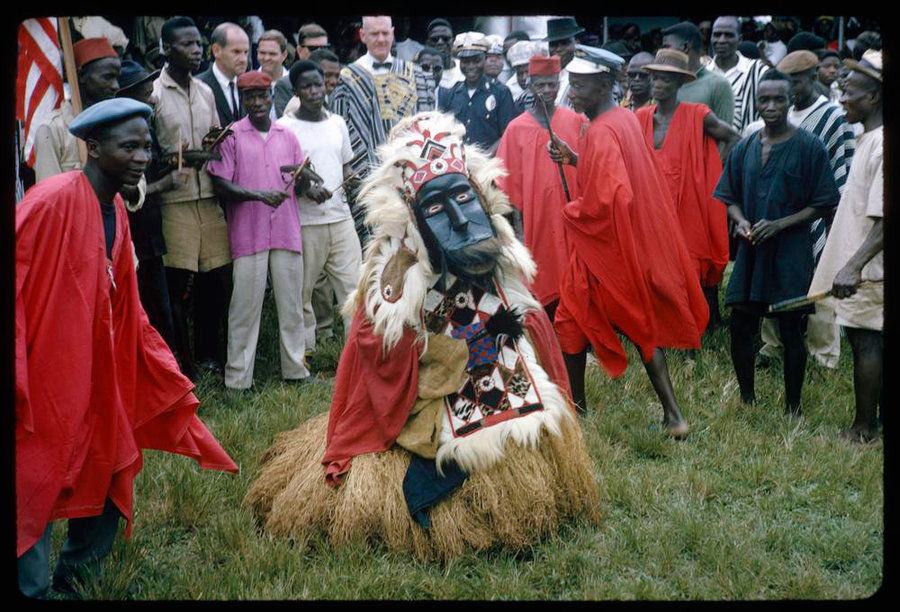
Liberia is known as the home of the "classical" African mask. The artistic ability of its wood carvers is widely recognized.
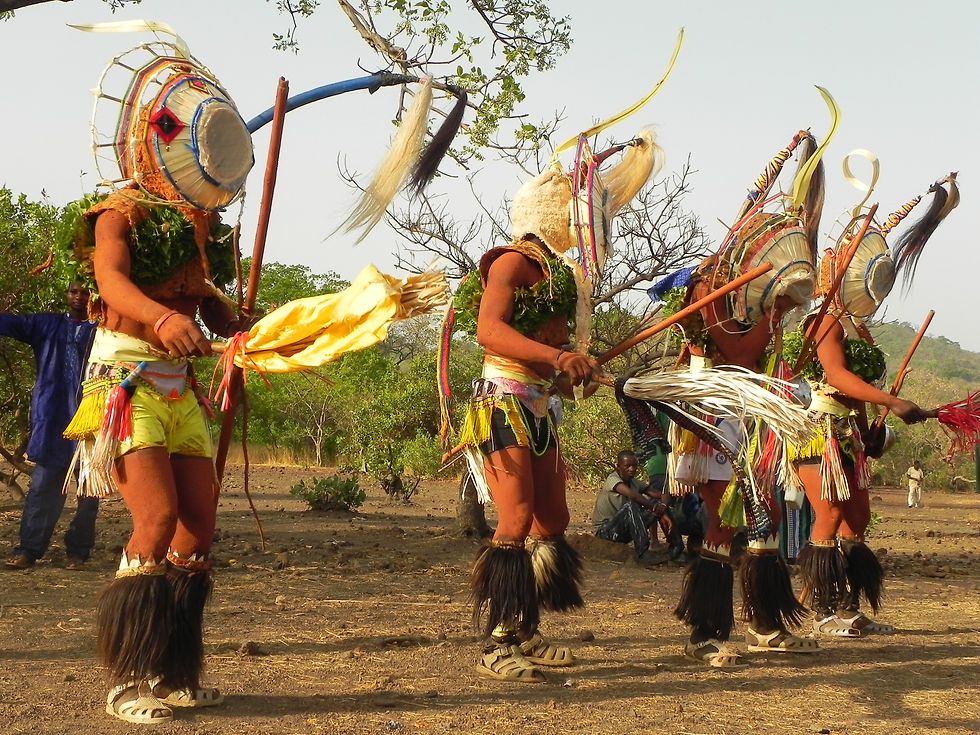
Many masks are commissioned by the Poro and Sande societies for use in their initiation rituals; some powerfully charged masks may be seen only by initiates, while others are used in public masquerades. Wooden masks are believed to connect the living with ancestral spirits and ancient deities
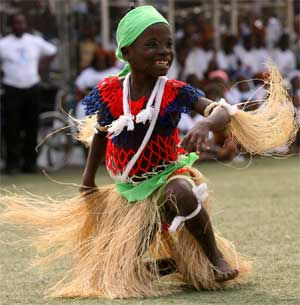
The range of forms produced by carvers is impressive as is the continuity of some styles over time. Other indigenous art forms include murals painted on the exterior walls of buildings, pottery, weaving, music, and dance.
LIBERIAN FOOD & RECIPES
Liberian cuisine reflects the rich heritage of Liberians. Certain American traditions are also reflected in Liberian recipes.
Liberian recipes contain an interesting melange of ingredients.
Often found in Liberian ingredients are cassava, peppers, sweet potatoes, tomatoes, ginger, palm oil and many tasteful vegetables.
Rice is one of the staple foods in Liberia. You will often hear a Liberian exclaim that he/she hasn't eaten all day, if they haven't had a rice dish for the day.
Dumboy (boiled and then pounded cassava) and Fufu/foofoo (derivative of cassava) are also staple Liberian side dishes.
From the Cassava leaf sauce coated in chunks of beef and chicken to the lush and delicious rice bread, Liberian cooking keeps one's taste buds asking for more...
RECIPES:
DRY RICE (one pot)
-
1 cups parboiled rice
-
1/2 lb. salted pork (or smoked fish)
-
1medium chopped onion
-
2 quarts boiling water (or more for softer rice)
-
1/4 tsp. pepper, if desired
-
1 tsp. salt, if desired
-
1 bouillons, chicken (or maggi cubes)
-
1 teaspoon oil/margarine/butter
Wash rice with hot water. Add water, rice and oil to pot. Bring rice to a rapid boil.
Add pepper, onions, smoked fish (or salted pork), maggi cubes, and salt. Reduce heat and simmer until rice is tender.
Serve immediately
POTATO GREENS (Fried)
3 “BUNCHES” of potato greens
4 bonnies (dried)
2 medium size onions
1 medium dry fish
1 ½lb beef and/or fried fish
1 pigfoot (boiled till tender)
2 pods hot pepper, salt, black pepper,
2 bouillon cubes
Remove stems and wash greens two to three times. Cut into fine shreds. Boil pigfoot until tender and salt free. Also, boil beef until tender. Save beef stock. Combine greens, onions, hot pepper and fry for about 10 minutes; stirring constantly. Remove bones from dry fish and bonnies and wash. Add beef dried fish, bonnies and tender pigfoot. Add the water in which beef was boiled and season to taste. Cook until all water is removed. Serve with hot rice or your favorite side dish.
CASSAVA LEAF SOUP
3 -8oz bags of defrosted grated cassava leaf
1 lb shrimp (with shells)
2 crabs (cleaned)
3 lbs chicken and beef
1 medium onion (chopped)
1 cup smoked turkey (diced)
1 1/2 tsp salt
4 bouillon cubes (maggi is great)
1/2 tsp ground black pepper
3/4 to 1 cup red palm oil
Wash your meat, chicken, fish, and seafood. Cut chicken into 1 1/2 inch pieces. Cut stewing beef into 1 inch pieces and smoked turkey into 1/2 inch pieces. If using bonnies, peel and remove bones. Clean crab and break apart. Combine all in pan with shrimp.
Add 1 tsp salt, 1/4 tsp black pepper, and 2 maggi cubes. Stir to spread seasoning evenly. Let sit for 20 minutes.
Put all your meat in a deep pot. Add one half of onion to pot. Add a small piece of Hot Pepper. Add 2 cups of water and cook half-covered on medium high for 20 minutes.
Spoon all your meats from pot and put in a bowl. Set aside.
Add cassava leaf to the pot with the remaining water. Add 2 maggi cubes, 1/2 tsp of salt, and 1/4 tsp of black pepper. Add second half of chopped onion.
Half cover pot and cook on medium. Stir frequently, scraping bottom of pan with cook spoon. Cook until water is almost dried.
Add meats and palm oil. Bring to boil on medium. Reduce heat to low, and continue to cook, stirring frequently. Be careful not to let the sauce stick to the bottom of the pan. Taste your sauce. If you would like more salt, add another maggi cube or carefully add more salt.
Cook until dry. Your sauce is dry when you can no longer see water bubbling in the sauce, about 30 to 45 minutes.
Serve with rice or favorite side dish.